
Why Mid-Winter Is the Best Time to Wash Your Heavy Bedding (Before It Gets Really Cold)
There's a particular kind of cold that settles in across most of Australia between late June and mid-August. In Victoria, South Australia, and the tablelands of New South Wales, it bites. In Queensland and Western Australia it's milder, but still enough to send everyone reaching for the heavy stuff, the thick doonas, the fleecy throws, the extra blankets pulled from the back of the wardrobe.
Here's the thing though. Most of us are so busy trying to stay warm that we put off washing the very items keeping us warm. Months go by. The doona that went onto the bed in late autumn has been through a lot by July. Skin cells, sweat, humidity, pet dander if you have a dog or cat who's decided winter is the perfect time to claim the bed. It adds up.
Mid-winter, right now, is actually the ideal moment to sort this out. Here's why it makes more sense than waiting until spring.
The hygiene case for washing now, not later
Winter bedding works hard. Unlike a sheet or a light summer quilt, a heavy doona or wool blanket is in contact with your body for eight or more hours every night, in conditions that are warm and often a bit damp. That combination is exactly what dust mites and bacteria thrive in.
Most health guidance suggests washing doonas every three to six months at a minimum. If yours went on in April, you're already at the three-month mark or beyond. Washing now means you're sleeping in something genuinely clean for the rest of the season, not just something that looks fine from the outside.
For families with young children, anyone with allergies or asthma, or households with pets, this matters even more. A good hot wash through a commercial machine is one of the most effective things you can do to reduce allergens in your bedroom.
Why home machines often aren't up to the job
This is where it gets practical. Even if you're motivated to wash your doona at home, the standard front-loader or top-loader in most rental properties or apartments simply isn't built for the task.
A queen or king doona stuffed into a domestic machine doesn't move properly through the wash cycle. It clumps, it doesn't agitate evenly, and it certainly doesn't rinse thoroughly. You can end up with detergent residue trapped in the fill, or a doona that's damp in the middle even after a full spin. Sleeping under something that hasn't fully dried, especially in winter, creates exactly the kind of moisture problem you're trying to avoid.
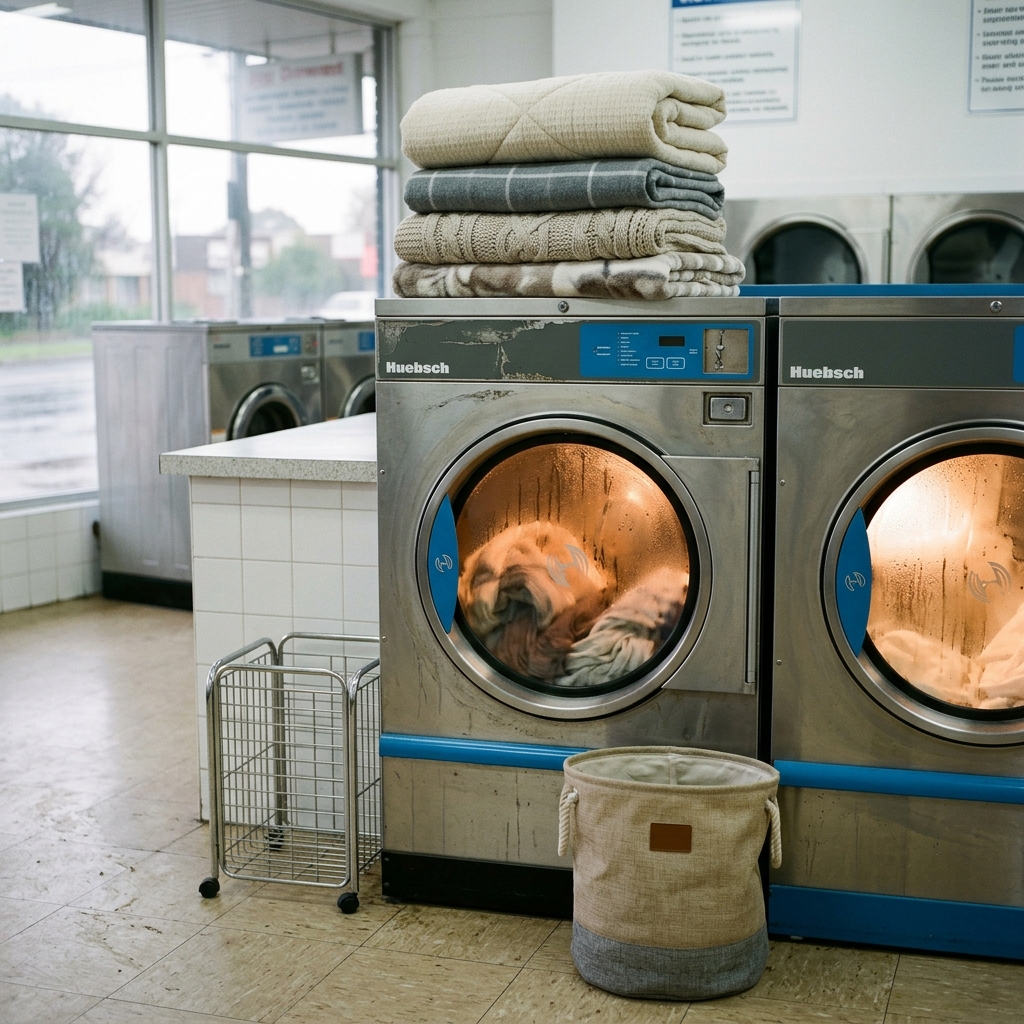
The large-capacity washers at a laundromat change all of this. Commercial machines are designed specifically for heavy, bulky loads. A 14 or 18 kilogram commercial washer gives your doona room to move, rinse properly, and come out genuinely clean rather than just surface-clean. The extraction cycle is more powerful too, so your items go into the dryer with significantly less residual moisture, which means faster, more thorough drying.
And the dryers themselves make a real difference. Commercial dryers run hotter and longer than domestic ones, and they can handle the volume. A big doona that might take two or three cycles in a home dryer gets done properly in one go. That matters when you're trying to get everything back on the bed the same day.
Getting it done in one efficient visit
The beauty of doing this mid-winter rather than waiting for a spring clean is that you can plan it as a single, purposeful trip rather than a scramble. Here's a simple approach that works well.
First, gather everything that needs a proper wash, not just the doona but the mattress protector, pillow protectors, and any heavy throws or blankets you've had in use since the cold started. Check the care labels for anything that needs a specific temperature, but most doonas and blankets are fine on a warm or hot cycle in a commercial machine.
Bring enough detergent for the load sizes you're planning to use. Laundromats often have detergent available but bringing your own means you can use whatever works for sensitive skin or allergies if that's relevant for your household.
Choose a time mid-week or during off-peak hours if your schedule allows. Saturday morning laundromats can get busy. A Tuesday or Wednesday visit gives you more space to spread out and use multiple machines at once if you have a big wash.
Load the heavy items into the largest machines available. A single queen doona usually needs a 14kg machine at minimum. A king doona or two large items together work best in an 18kg drum. Don't be tempted to overfill, the whole point is giving things room to move.
Add your title here
This is a paragraph. Writing in paragraphs lets visitors find what they are looking for quickly and easily. Make sure the title suits the content of this text.

City skyline
Photo By: John Doe

Birthday Sparks
Photo By: John Doe

Fashion Magazine
Photo By: John Doe

Blurred Lines
Photo by: John Doe
Contact Us Amy Time
Thank you for contacting us. We will get back to you as soon as possible.
Oops, there was an error sending your message. Please try again later.